
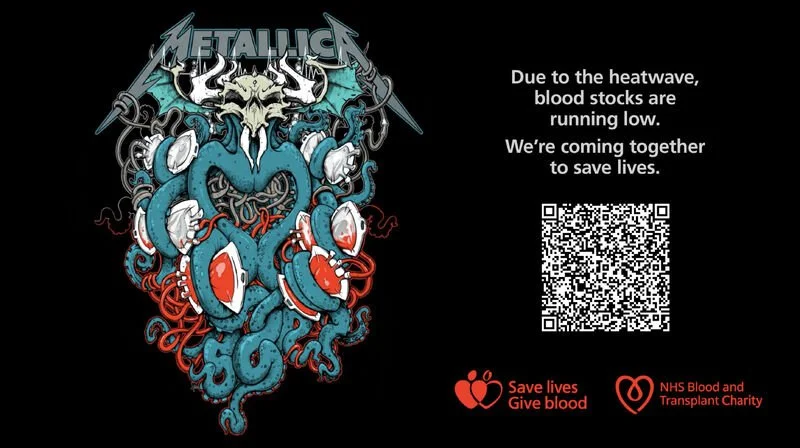
On paper, the NHS and Metallica have nothing in common. One is a 78-year-old British institution, the other is a band grown from a culture of anti-establishment. But the pair are currently collaborating, with the timing built around the UK leg of Metallica's M72 World Tour, in an effort to drive up blood donor numbers.
What is it?
NHS Blood and Transplant, alongside the Welsh Blood Service and Scottish National Blood Transfusion Service, partnered with Metallica and the band's charity, All Within My Hands, in what's being described as the first collaboration of its kind between UK blood services and a global rock act at this scale. Fans were encouraged to book donation appointments around tour dates in Glasgow, Cardiff and London, with limited-edition merchandise, t-shirts at donor centres, guitar picks at mobile units, offered while stocks lasted as an incentive to take part.
The campaign leaned into visual shock. As part of NHS Blood and Transplant's Emergency LOW-GOS campaign, Metallica's famous logo was shown draining of colour across the giant tour screens at London Stadium, depicting the NHS’s blood stocks running low. Brands like Marvel and HSBC UK have already lent their red logos to the same campaign, but Metallica's involvement pushed it towards a different audience, using a different tone, and allowed it to carry a different set of symbolism
Why metal?
Metal, as a music genre, has industrial roots. Black Sabbath, widely acknowledged as releasing the first true heavy metal album, emerged from the factory scene of Birmingham. Factory workers, working the assembly lines, conceptualised the genre's distinctive sonic profile, which include loud, hammering, repetitive sounds, echoing that industrial environment.
Metal also served as a direct rejection of the peace-love-and-light utopianism that had come to define the hippie middle class, who were rejecting the corporate culture of their parents, and metal sought to shock rather than soothe. In doing so, metal has always targeted institutions it sees as oppressive, and frequently explores taboo subjects, allowing it to occupy a countercultural space, despite increased commercialisation of the genre in the 1990s.
Blood has always been symbolic within the metal scene. It is abrupt, shocking, and serves to reject the idea that these themes need to be sanitised. But blood is also regenerative, and metal has long been discussed for its catharsis, supporting mental health, and bringing people together around pain rather than brushing over it. So, a partnership with the NHS feels like a natural extension of themes and imagery the genre has always dealt in.
The UK faces an ongoing blood shortage that has detrimental effects on patient care. Data from 2019 shows that for every 100 women who donated blood, only 70 men did. Given that Metallica’s audience is predominantly middle-aged men, this campaign was a strategic, targeted effort. This is particularly important because some neonatal transfusions require blood specifically from male donors, and only male blood is used to create Fresh Frozen Plasma, which is essential for trauma patients suffering from massive blood loss or rare diseases.
A campaign built on a real, specific, urgent shortage, rather than a vague call to "do good," aligns well within a genre that has always rejected empty gestures and performativity. This also follows a longer history of alternative music communities commenting on societal deficits and mobilising their members to act. Metallica has emphasised the campaign as part of something bigger than the show itself, tied to the NHS's need for repeat donors.
The NHS Blood and Transplant has also previously attempted to borrow cultural capital for donations. In 2015, its “Missing Type” campaign saw 1000 organisations, from Downing Street to Google, strip the letters A, O and B from their branding. While this drove 30,000 sign-ups, it is a mistrusted institution borrowing from other mistrusted institutions (government and tech). The Metallica campaign allows the NHS to be embedded within a specific subculture, and align with a long history of values and activism.
Why is this important?
This is reportedly the first time UK blood services have partnered with a rock act at this scale, despite following a longer NHS tradition of using cultural credibility. The campaign isn't an exercise in reach for its own sake, but is about scarcity, the consequences this has for communities, and taking action, aligning comfortably within a culture and genre that has never been interested in pretending things are fine.
